
News Releases
2 New Below
News release of June 24, 2026
Quebec Announces New Spousal Sponsorship
Intake Periods for 2026–2028
The Quebec government has announced new intake periods for certain spousal sponsorship applications for the 2026–2028 period.
Under a Ministerial Order published in the Gazette officielle du Québec on June 23, 2026, sponsors seeking to submit a Quebec undertaking for a spouse, common-law partner, or conjugal partner may only do so during specific intake periods.
The applicable intake period depends on the date on which Immigration, Refugees and Citizenship Canada (IRCC) issued either the sponsor’s proof of eligibility or the acknowledgement of receipt (AOR) for the federal sponsorship application.
| You can submit your application as of: | If your IRCC eligibility letter or acknowledgment of receipt is dated no later than: |
|---|---|
| July 2, 2026 | July 31, 2024 |
| September 1st, 2026 | January 31, 2025 |
| November 1st, 2026 | June 30, 2025 |
| January 1st, 2027 | August 31, 2025 |
| March 1st, 2027 | October 31, 2025 |
| May 1st, 2027 | November 30, 2025 |
| July 1st, 2027 | December 31, 2025 |
| September 1st, 2027 | February 28, 2026 |
| November 1st, 2027 | May 31, 2026 |
| January 1st, 2028 | August 31, 2026 |
| March 1st, 2028 | December 31, 2026 |
| May 1st, 2028 | December 31, 2026 |
Please double check with the Quebec government websites regularly. The above dates have changed before and may change in the future.
Sponsors should carefully review the applicable intake period before submitting their Quebec undertaking application. Applications submitted outside the designated intake period may not be accepted.
The Ministerial Order also confirms that these intake limits do not apply to certain sponsorship applications, including those involving dependent children and certain orphaned relatives.
Individuals planning to sponsor a spouse or partner in Quebec should ensure that both the federal and provincial stages of their application are carefully coordinated to avoid delays.
Source: Gouvernement du Québec, Gazette officielle du Québec, Ministerial Order dated June 15, 2026, published June 23, 2026, respecting the management of applications in the Family Reunification category for the 2026–2028 period.
News release of June 17, 2026
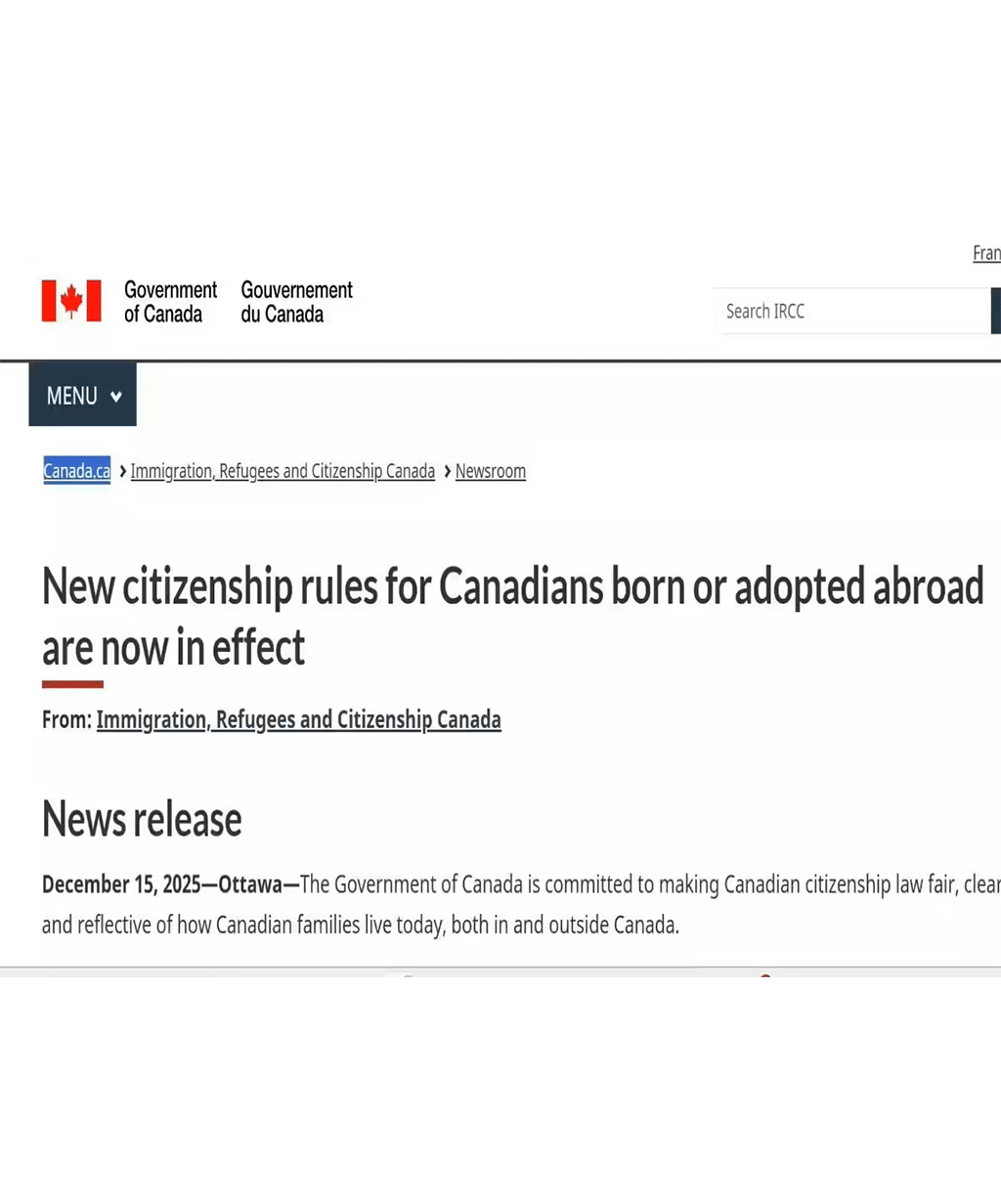
Canada’s New Citizenship by Descent Framework: A Positive Six-Month Update
Belonging, identity, and citizenship shape people’s lives. Many families carry Canada in their hearts and their experience shows why citizenship is “more than just paperwork.” Senator Mary Coyle has perfectly put this feeling into words: “its both a privilege and a profound bond, and for many of those we are talking about today, its actually a right.” (Senate Gro). Canada records offices have experienced a surge in popularity following the Carney administration’s newly released Bill C-3. With over 82,000 applications waiting for approval, the new citizenship by descent rules are truly being enjoyed after 6 months of being opened (IRCC). There is a 15 months wait time for applications being submitted today. With such a huge number of people waiting for a decision, the queue can only get longer (IRCC). The most exciting changes have been the retroactive citizenship status and the eligibility being extended through ancestral lines, such as grandparents, great-grandparents, or even earlier ancestors. There has been a huge influx in American applications seeking Canadian citizenship. (Global News). There are many real-world benefits of qualifying, such as the ability to move or work in Canada, massive tuition savings through heavily subsidized domestic university fees, and participate in Canada’s universal provincial healthcare programs. Global mobility is much easier in certain countries, such as China, for leisure travel without visa with a Canadian passport, a benefit that comes with qualifying under Bill C-3. . (Citizenship Counts).
Anyone born outside of Canada before December 15th 2025 with Canadian lineage can now qualify for Canadian citizenship by descent. What comes into effect is people who automatically became Canadian citizens can apply to get a proof of citizenship. Bill C-3 has finally ended the first-generation limit, which prevented many from being recognized as Canadian. On December 19, 2023, the Ontario Superior Court of Justice found that the first-generation limit to citizenship by descent was discriminatory to people who lost their ancestral heritage, thereby unconstitutional (IRCC). This is prominent to Canadian women who marry foreign nationals and are unable to pass on their citizenship to first generation children abroad. (Department of Justice). The Government of Canada recognized this decision, and introduced Bill C-3. This change signifies a protection of the values of Canadian citizenship and an extension beyond first-generation persons that is more inclusive. This is appealing interesting for “Lost Canadians,” people who lost their citizenship because of certain outdated rules in earlier citizenship laws. Bill C-3 extends access to citizenship to this group and their descents. “Many Canadian chose to study abroad, travel to experience another culture, or relocate for family/personal reasons and still have a meaningful connection to our country. This new legislation strengthens the bond between Canadians at home and around the world, and reaffirms the values we hold as nation,” says The Honorable Lena Metlege Diab, Minister of Immigration, Refugees and Citizenship. (IRCC).
https://www.justice.gc.ca/eng/csj-sjc/pl/charter-charte/c3_2.html
https://citizenshipcounts.ca/benefits
https://www.passportindex.org/passport/canada
https://senate-gro.ca/c3-lost-canadians
https://www.pexels.com/photo/a-boy-and-a-girl-holding-corners-of-a-flag-7144465/